Male-Coded Peafowl Representation in Television, Museum Collections, English Print, and Fashion
Abstract
The Indian peafowl (Pavo cristatus) divides its most commercially legible ornament along sex lines: adult males carry the iridescent blue neck, elongated train, and ocellated feathers that made the “peacock” an international emblem of display, while females lack the train. This study began with an unsystematic observation: across several editions of the reality competition The Traitors, every peafowl that appeared on screen was male. I examined that question across three archives. The Metropolitan Museum of Art tags 467 objects “Peacocks,” has no tag for peahens at all, and files a porcelain peahen under “Birds” while her mate receives a tag of his own; 141 object titles name the peacock and 2 name the peahen. iSpot.tv indexes 26 nationally aired U.S. television ads under “Peacocks” and offers no female-coded category. Exact binomial arithmetic on those counts produces vanishing tail areas, but neither archive runs the random experiment such a test assumes, so the probabilities demonstrate a model rather than measure a bias. In English books from 1800 to 2022, “peacock” and “peacocks” outnumber “peahen” and “peahens” 57 to 1. The control species narrow that inference: “lion” beats “lioness” by nearly as much, and the female nouns “goose” and “duck” beat “gander” and “drake” by about 20 to 1, so the lexical ratio measures markedness rather than ornament. The institutional categories are where peafowl stand apart. Both archives name the cow and both keep a neutral category for chickens; neither gives the peahen a word of her own. NBC’s corporate history and museum dress records show the same selection at work: industries that trade in visibility choose the sex that evolution already optimized for conspicuous display. The resulting avian glass ceiling does not erase the peahen from nature. It erases her from the visual shorthand by which culture decides what a peafowl looks like.
Introduction
This study began as a viewing habit. Over a period of sustained viewing, I watched the American edition of The Traitors, then the British celebrity edition, then the British civilian edition (The Traitors [US] 2023–; The Celebrity Traitors 2025–; The Traitors [UK] 2022–). All three take place at Ardross Castle in the Scottish Highlands (Bryan 2026; Hunt 2025), and all three return, often, to the castle’s peafowl. A journalist who visited the set heard “the caw of the resident peacocks,” and the executive producer reported that the birds “always go to the catering tent” (Hunt 2025). The series used the birds generously, and in every appearance I noticed, the bird was male. I did not see a peahen.
The observation came during a remarkable year for NBC. On November 15, 1926, the National Broadcasting Company inaugurated its radio network from New York’s Waldorf Astoria (Library of Congress n.d.). The corridor that joined the hotel’s two buildings had been called Peacock Alley since the 1890s, after the guests who paraded along it (Hilton n.d.). NBC began under the same roof as a peacock, 30 years before it adopted one. In 2026, NBC marks its centennial, the Peacock marks 70 years since its 1956 introduction, and the six-plumed corporate emblem unveiled in 1986 turns 40 (NBCUniversal 2026). The original 11-plumed bird promoted color programming and, through NBC’s then-owner RCA, color television sets (NBCUniversal 2026; NBCUniversal n.d.). The symbol’s spectacular color was not a species-wide qualification: the elongated, iridescent train belongs to male peafowl. A century after NBC’s debut, the American edition of The Traitors streams on Peacock, the network’s namesake service (Peacock n.d.). The bird on the screen was a peacock, and so was the screen.
An unsystematic observation cannot carry a finding, and I did not count the shots. I regret this. The observation can, however, generate a hypothesis. This paper follows that question across three archives larger, and considerably less exciting, than reality television. It describes what those records contain, and what a statistical test of them can and cannot show.
Peafowl pose a lexical problem before they pose a statistical one. “Peafowl” names the group; “peacock” names the male; “peahen” names the female. The words did not arrive together. English inherited a sex-neutral Old English word, pēa, from the Latin pavo. It attached “cock” to that word by the fourteenth century and “hen” by the fifteenth, and it did not coin “peafowl” until about 1790 (Merriam-Webster n.d.-a, n.d.-b, n.d.-c). For roughly four centuries English had no compound for the species as a whole, and the male noun filled the gap. Merriam-Webster still lists “peafowl” as a broad sense of “peacock” (n.d.-a). Popular visual culture continues the substitution, which the spectacular sexual dimorphism of the Indian peafowl makes unusually easy.
Biology supplies the raw material. The Cornell Lab of Ornithology describes the adult male as brilliant blue with an extremely long train and the female as brown above, greenish-brown at the neck, and without the male’s elongated train (Cornell Lab of Ornithology n.d.). The Smithsonian’s National Zoo credits the male with a five-foot train bearing 100 to 175 ocelli and describes females as “more drably colored, with a shorter train that lacks ocelli” (Smithsonian’s National Zoo and Conservation Biology Institute n.d.). The Denver Zoo calls the female “drab” in the same sentence that records her “greenish neck feathers” (Denver Zoo n.d.). The language of description ranks the sexes before any advertiser arrives.
This paper treats the Traitors observation as exploratory and examines its proposition across three documentary corpora: the metadata of nationally aired U.S. television advertising, the subject tags and titles of the Metropolitan Museum of Art’s open-access catalog, and sexed peafowl nouns in English books since 1800. Control species (lions, tigers, geese, ducks, chickens, and cattle) reveal what is distinctive about peafowl and what follows from ordinary naming conventions. Historical cases trace the appeal of the male phenotype in NBC’s promotion of color television and in women’s fashion. Together these archives address a narrow empirical question with broad cultural consequences: when visibility has value, which peafowl gets the job?
Background
Sexual selection and the contested peahen
Darwin found the problem physically uncomfortable. “The sight of a feather in a peacock’s tail, whenever I gaze at it, makes me sick!” he wrote to Asa Gray in 1860 (Darwin 1860). The train seemed to contradict natural selection, and Darwin resolved the difficulty by assigning its explanation to female choice (Darwin 1871). His contemporaries doubted that a hen could exercise taste, and biologists argued over female choice for the next century (Milam 2010). Later work supports parts of that account. Petrie et al. (1991) reported that peahens preferred males with more elaborate trains. Eye-tracking shows peahens directing their gaze to the lower portion of the train during courtship (Yorzinski et al. 2013), and biomechanical studies treat the train as a multimodal signal whose cost to takeoff is smaller than its size suggests (Askew 2014; Dakin et al. 2016).
The peahen’s verdict remains contested. After seven years of observation, Takahashi and colleagues (2008) found no consistent female preference for longer trains, more eyespots, or more symmetrical eyespot arrangements. Dakin and Montgomerie (2011) titled their own results with unusual candor: peahens prefer peacocks displaying more eyespots, “but rarely.” The field evidence does not establish that peahens care about the train as much as the train’s reputation suggests. That uncertainty returns in the Discussion.
The male default in natural history
Visual culture is not the only archive that prefers the ornamented sex. Cooper and colleagues (2019) examined bird and mammal specimens in major natural history collections and found that female birds made up about 40% of the bird specimens, a proportion that had not changed in 130 years and that fell lower in species whose males carry showy traits such as colorful plumage. Scientific collectors had every professional reason to sample both sexes and still over-collected the ornamented male. An advertiser with 30 seconds of airtime and a product to move faces fewer incentives to do better.
Haraway’s “Teddy Bear Patriarchy” supplies the precedent for reading museum display as an argument rather than a window. In her account of the American Museum of Natural History’s Akeley African Hall, the habitat groups place a vigilant adult male beside females and young, and the arrangement presents one historically situated family order as natural fact (Haraway 1984–85, 24–25). The female is not always absent. The display assigns her a position inside a scene curated to look uncurated. This study examines a later stage of the same process: the labels through which an institution decides what a visitor can find.
The default reaches the nursery and the nomenclature. In 5,618 American children’s books published across the twentieth century, male animals were central characters in more than 23% of books per year and female animals in 7.5% (McCabe et al. 2011). Schiebinger (1993) traced Linnaeus’s decision to name a class of animals for the breast, Mammalia, to eighteenth-century arguments about women and nursing. Taxonomy has never been neutral ground.
The unmarked sex
Linguists have a name for the pattern. In a marked pair, one term carries the general meaning and the other adds a restriction: “lion” covers the species, and “lioness” marks the female. Tannen (1993) described the unmarked form as carrying “the meaning that goes without saying.” Beauvoir ([1949] 2011) made the same observation about men, who occupy both the positive and the neutral position, and Hofstadter (1985) satirized it by transposing sex onto race. English usually leaves the male unmarked, but not always. “Goose” and “duck” are the female nouns, and “gander” and “drake” are the marked ones. Peafowl are a harder case. “Peacock” and “peahen” are both compounds, each marked for sex, and the language still treats the first as the default. The control species in this study help distinguish two explanations for that preference: the grammar of markedness and the pull of the ornament.
Who looks at whom
Feminist film theory supplies the terms for a paradox in the peafowl case. Mulvey (1975, 11) described the woman of classical cinema as coded to “connote to-be-looked-at-ness,” and Berger (1972, 47) compressed the arrangement into four words: “men act and women appear.” Peafowl invert it. The peacock is the one to be looked at, and the peahen is the one who looks; Yorzinski and colleagues (2013) measured her gaze with eye-tracking equipment. In human terms, the peacock occupies the position that visual culture codes as feminine.
Television supplies another stage. Cynthia Chris (2006) examines wildlife programming’s presentation of animal behavior as unmediated nature and shows how favored species and mating narratives can carry human ideas about gender, sexuality, and race. This study examines advertising, reality television, and a network emblem rather than a representative sample of wildlife documentaries. Chris’s analysis still clarifies why selecting a photogenic animal and calling the result “nature” is already an editorial act.
Dress history adds a second inversion. Flügel (1930) gave the name Great Masculine Renunciation to the late eighteenth-century shift in which European men abandoned bright and elaborate dress and left ornament to women. After the renunciation, the most elaborate available ornament, including the peacock’s, belonged on women’s bodies. The fashion evidence below follows from that history: women wore the male bird’s ornament, and the female bird contributed nothing to the wardrobe.
The goddess’s bird
Western iconography long assigned the peacock to a female owner. Ovid has Juno set the 100 eyes of the slain watchman Argus in the tail of her bird (Ovid, Metamorphoses 1.722–23), and the Metropolitan Museum’s catalog returns Juno with her peacock in title after title, from engraved allegories of marriage to a cup whose finial shows “Juno with a Peacock” (Metropolitan Museum of Art 2026). Arthur Silver’s peacock textile for Liberty & Co. bears the name “Hera,” the Greek counterpart of the same goddess (Metropolitan Museum of Art n.d.-a). Augustine reported that peacock flesh resisted decay (Augustine, City of God 21.4), a belief that made the bird a Christian emblem of immortality; the Met still describes the motif as “symbolizing beauty, immortality and exoticism” (Metropolitan Museum of Art n.d.-b). For 2,000 years the most famous peacock in Western art belonged to a queen, and she owned a male bird. The arrangement anticipated the modern one: female patronage, male ornament, and no role for the peahen.
Materials and Methods
Exploratory observation
The motivating observation came from ordinary viewing of three editions of The Traitors produced at Ardross Castle: the American series on Peacock (The Traitors [US] 2023–), The Celebrity Traitors on BBC One (2025–), and the British civilian series on BBC One (The Traitors [UK] 2022–). I noted the sex of peafowl that appeared on screen. I did not count appearances, log timestamps, or code episodes, and I report the observation only as the source of the hypothesis. It enters none of the statistical calculations.
Television corpus
The television corpus consisted of the 26 nationally aired U.S. television ads that iSpot.tv indexes under its animal category “Peacocks” (iSpot.tv n.d.-e). On the date of access, the public category page displayed 20 of the 26 ads; the remaining six require registration. Supplementary table S1 lists the 20 visible ads, which come from 13 advertisers.
The unit of analysis was the indexed ad and its sex-coded metadata, not the biological sex of any bird. An ad received a male-coded value when its indexing term used the sex-specific English noun “peacock” and a female-coded value when the term used “peahen.” The method measures which sex supplies the public-facing category through which nationally aired advertising becomes searchable. It does not measure the chromosomes of every bird that crossed a set.
Museum corpus
The museum corpus consisted of the Metropolitan Museum of Art’s Open Access dataset (MetObjects.csv), downloaded on November 13, 2026, at commit d31d26f, which contains 503,207 object records with metadata dated through November 7, 2026. An earlier download, on October 29, 2026, held 503,012 records and returned the same counts (Metropolitan Museum of Art 2026). I searched two fields. The Tags field holds the museum’s controlled subject vocabulary; the Title field holds curatorial titles assigned object by object. I counted records whose tags or titles contained “peacock” or “peacocks,” “peahen” or “peahens,” or “peafowl,” matching whole words without regard to case.
Lexical corpus
To estimate the noun’s dominance outside any single institution, I queried the English corpus of the Google Books Ngram Viewer for the lowercase forms “peacock,” “peacocks,” “peahen,” “peahens,” and “peafowl” from 1800 to 2022, case-sensitive and without smoothing (Google n.d.; Michel et al. 2011). Restricting the query to lowercase forms excludes most surnames and brand names, including NBCUniversal’s streaming service. For each year I computed the peahen share of sexed peafowl nouns, (peahen + peahens) / (peacock + peacocks + peahen + peahens), and fitted an ordinary least-squares trend to the annual series. Supplementary Data S2 preserves the 223 annual observations for all 21 queried terms and the formulas behind these comparisons. Each reported whole-period ratio divides the sum of yearly normalized frequencies for the default noun and its plural by the corresponding sum for the sex-marked noun and its plural. These values are not counts of raw word tokens. The archived observations, rather than a future revision of Google’s live corpus, are the replication target.
Control species
To separate the peacock’s case from the ordinary behavior of English, I repeated the lexical query for four other sexed pairs: lion and lioness, tiger and tigress, goose and gander, and duck and drake, each with its plural and under the same settings (Google n.d.). In the first two pairs the male noun is the unmarked form; in the last two the female noun is. I then recorded how the two archives categorize peafowl and three comparison species: chickens, cattle, and lions. On November 13, 2026, I searched iSpot.tv for each sexed and neutral noun, noted the animal categories the site returned, and recorded the number of nationally aired ads each category reports (iSpot.tv n.d.-a). For the Met I counted the objects that carry each subject tag in the same dataset. Chickens are the closest control available. They belong to the same family as peafowl, Phasianidae, and English sexes them with the same two words, cock and hen. I chose the controls to contrast male-default and female-default nouns and to compare institutional categories. They are not a representative sample of animal species or visual media.
Statistical analysis
For the television and museum-title counts, I first report what the archives contain. I then impose a null model that nobody should believe: each entry independently selects male-coded or female-coded terminology with equal probability, H₀: p = 0.50, against H₁: p > 0.50, though I report two-sided exact-binomial tail areas. Neither archive runs that experiment. Advertisers and curators do not draw sex-specific nouns independently at even odds, and nothing suggests they ever did. The null is a symmetry benchmark, not an estimate of anything. Under that model I computed exact Clopper–Pearson intervals and Cohen’s h (Clopper and Pearson 1934; Cohen 1988), and checked the arithmetic in Python 3.13 with SciPy 1.17.0 (Virtanen et al. 2020). The resulting numbers describe the model. They do not test the institutions.
Historical sources
The historical analysis treated corporate and museum documentation as evidence of selection criteria, not as additional statistical samples. NBCUniversal’s centennial history of its logo documents the network’s adoption of the peacock (NBCUniversal 2026). The fashion analysis draws on catalog records from the Metropolitan Museum of Art and the National Trust and on scholarship on feather garments and on Lady Curzon’s Peacock Dress (Metropolitan Museum of Art n.d.-a, n.d.-b; National Trust n.d.; Keefe 2016; Thomas 2007; Onken 2022).
Visual cross-checks
I inspected the Met’s published images and curatorial descriptions of the Bow porcelain peacock and peahen (ca. 1760; accession nos. 64.101.726–64.101.727) and the Chelsea porcelain pair (ca. 1755–58; accession nos. 64.101.480 and 64.101.481), alongside NBC’s documented emblem designs (Metropolitan Museum of Art 2026, n.d.-c, n.d.-d; NBCUniversal 2026). I compared elongated trains, eyespot ornament, coloration, and curatorial sex designations. These purposively chosen objects are historical case studies, not a random visual census, and none contribute observations to the binomial tests.
Figures
The figures use two colors, both sampled from the Bow porcelain pair in figure 3: the blue of the peacock’s neck for male-coded quantities and the brown of the peahen’s back for female-coded ones. Gray marks sex-neutral categories and reference values. Figure 7 alone uses six colors, because its subject does.
Results
The strongest result is institutional rather than probabilistic. The Met applies the tag “Peacocks” to hundreds of objects and has no tag for peahens at all. iSpot’s peafowl entries repeat the asymmetry. Neither fact requires a coin toss. The binomial distributions below show what a textbook symmetry model does to these classifications.
Television metadata
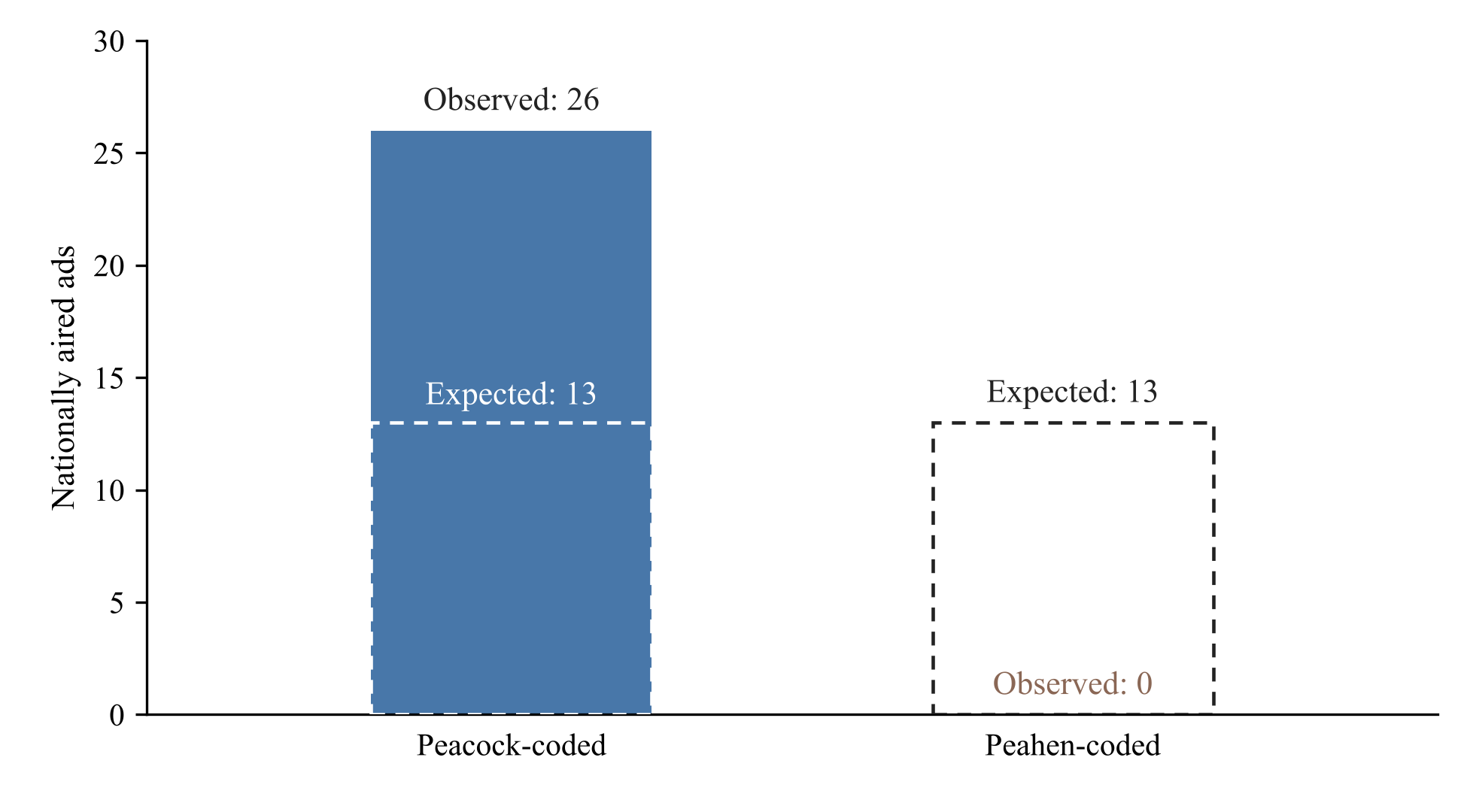
The category structure produced an unusually tidy descriptive result: iSpot.tv lists 26 nationally aired ads under “Peacocks” and no corresponding “Peahens” category (fig. 1). The count describes how one vendor makes advertisements searchable. It does not show which birds actually appeared on screen. A 50:50 naming model expects 13 per category, and figure 1 marks that expectation. A further site search for “peahen,” “peahens,” and “peafowl” returned no ads and no categories (iSpot.tv n.d.-a).
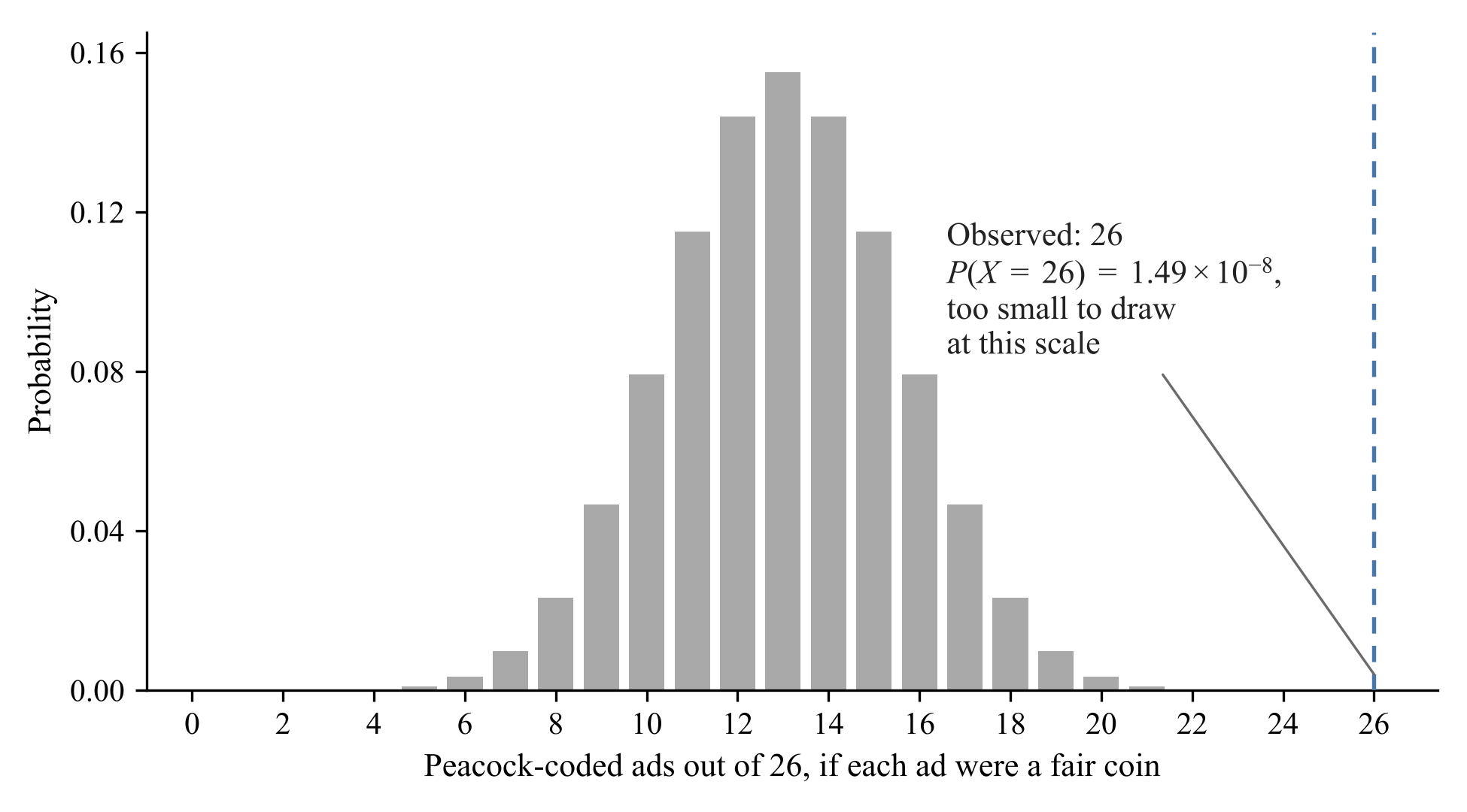
Under that model the exact binomial arithmetic yields a one-sided tail area of 1.49 × 10⁻⁸ and a two-sided value of 2.98 × 10⁻⁸ (fig. 2). A fair-coin model would produce either extreme—26 to 0 or 0 to 26—about three times in 100 million sequences. The exact interval runs from 0.868 to 1.000, while Cohen’s h equals 1.57.
Both statistics reached their mathematical limits. Against a null of 0.50, Cohen’s h cannot exceed π/2, or 1.5708, and the observed value equals π/2. With 26 trials, no outcome produces a two-sided tail area smaller than 2.98 × 10⁻⁸. The analysis therefore documents a second glass ceiling, this one built into the arithmetic. The peacock reached both.
The individual ads reinforce the semantic pattern. Arby’s built a spot around a “therapy peacock”; Autotrader placed a pet peacock among Andy Cohen’s deliberately extravagant possessions; McDonald’s populated an athlete’s mansion with peacocks as part of a visual vocabulary of conspicuous wealth (iSpot.tv n.d.-b, n.d.-c, n.d.-d). Peacock TV hatched a fully grown peacock from an egg on a chicken farm, raised a grand piano through the barn floor, and set him under a spotlight to play Vanessa Carlton’s “A Thousand Miles” (iSpot.tv n.d.-f). The spot skips the juvenile years during which young males resemble hens. Even at birth, the commercial peafowl is a peacock.
The Enchantimals spot in the same category approaches the pattern from the other direction. The doll line’s peafowl character, Patter Peacock, is a girl. She carries the male noun as her surname, and her companion bird, Flap, is a “he” (Mattel n.d.; iSpot.tv n.d.-e). In each of these ads the bird arrives already carrying a cultural résumé: spectacle, wealth, vanity, excess, theatricality, and the promise that someone spent more on decoration than strictly necessary.
Museum cataloging
The Metropolitan Museum’s controlled vocabulary supplies a more direct institutional finding. The subject tag “Peacocks” occurs on 467 objects, and no “Peahens” or “Peafowl” tag occurs anywhere in the dataset (table 1). A peahen cannot be counted under a category the vocabulary never supplies. No null hypothesis produced that asymmetry. The institution did.
Object titles provide a second descriptive measure, though curators across objects and departments share institutional naming conventions. The catalog contains 141 titles with a male-specific peacock noun and 2 with a female-specific peahen noun (98.6% versus 1.4%). Under the same artificial independent 50:50 benchmark, those counts generate a two-sided binomial value of 1.85 × 10−39, a nominal exact interval of 95.0%–99.8%, and Cohen’s h of 1.33. Nine of the 141 male-coded titles refer to things named for the bird rather than the bird itself: the Peacock Throne (three titles), the Peacock Room, a peacock moth, the Peacock Wisdom King, two books, and Garry Winogrand’s photograph of Peacock Alley. Removing them leaves 132 titles to 2 (98.5%). The naming imbalance survives that straightforward sensitivity check.
Table 1. Sex-coded peafowl terms in the Metropolitan Museum of Art Open Access catalog (503,207 records)
| Field | Peacock or peacocks | Peahen or peahens | Peafowl |
|---|---|---|---|
| Subject tags | 467 | 0 (no such tag) | 0 (no such tag) |
| Object titles | 141 | 2 | 3 |
Source: Metropolitan Museum of Art (2026). Whole-word matches without regard to case.
The exceptions show the vocabulary at work (table 2). Bian Lu’s fourteenth-century hanging scroll Peahen and Hibiscus carries a female noun in its English title and the subject tag “Peacocks.” Its Chinese title uses kongque (孔雀), a word that does not specify sex. Around 1760 the Bow Porcelain Factory made a matched pair of figures (fig. 3). The Met titles them Peacock (one of a pair) and Peahen (one of a pair), tags the male “Peacocks,” and tags the female “Birds.” Of the three objects titled with the neutral “peafowl,” a Ming lacquer dish received “Peacocks,” an English earthenware plate received only “Birds,” and a Japanese drawing for metalwork received no tag. When a peahen enters the catalog, the vocabulary files her under the male tag or under “Birds.”
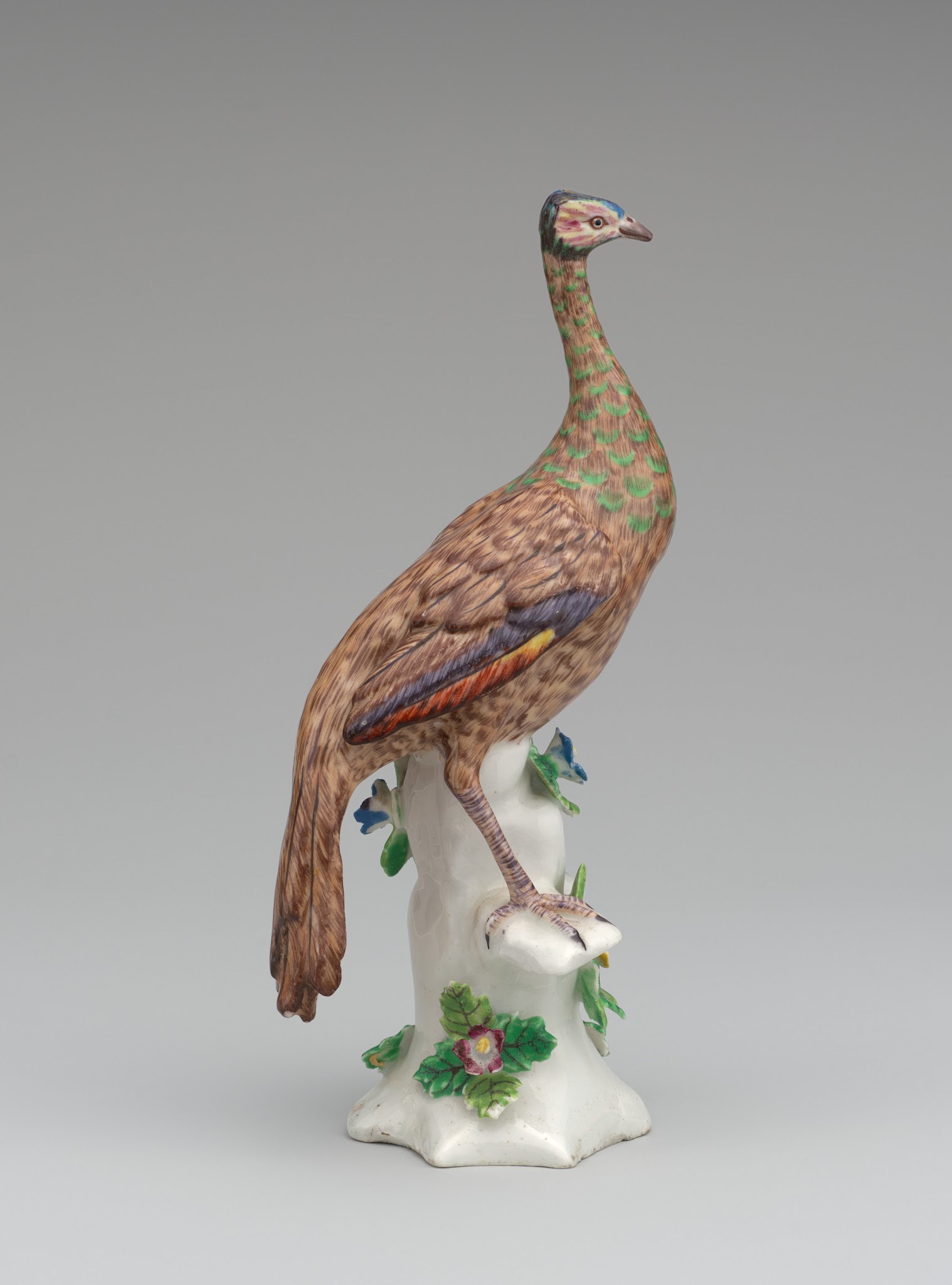
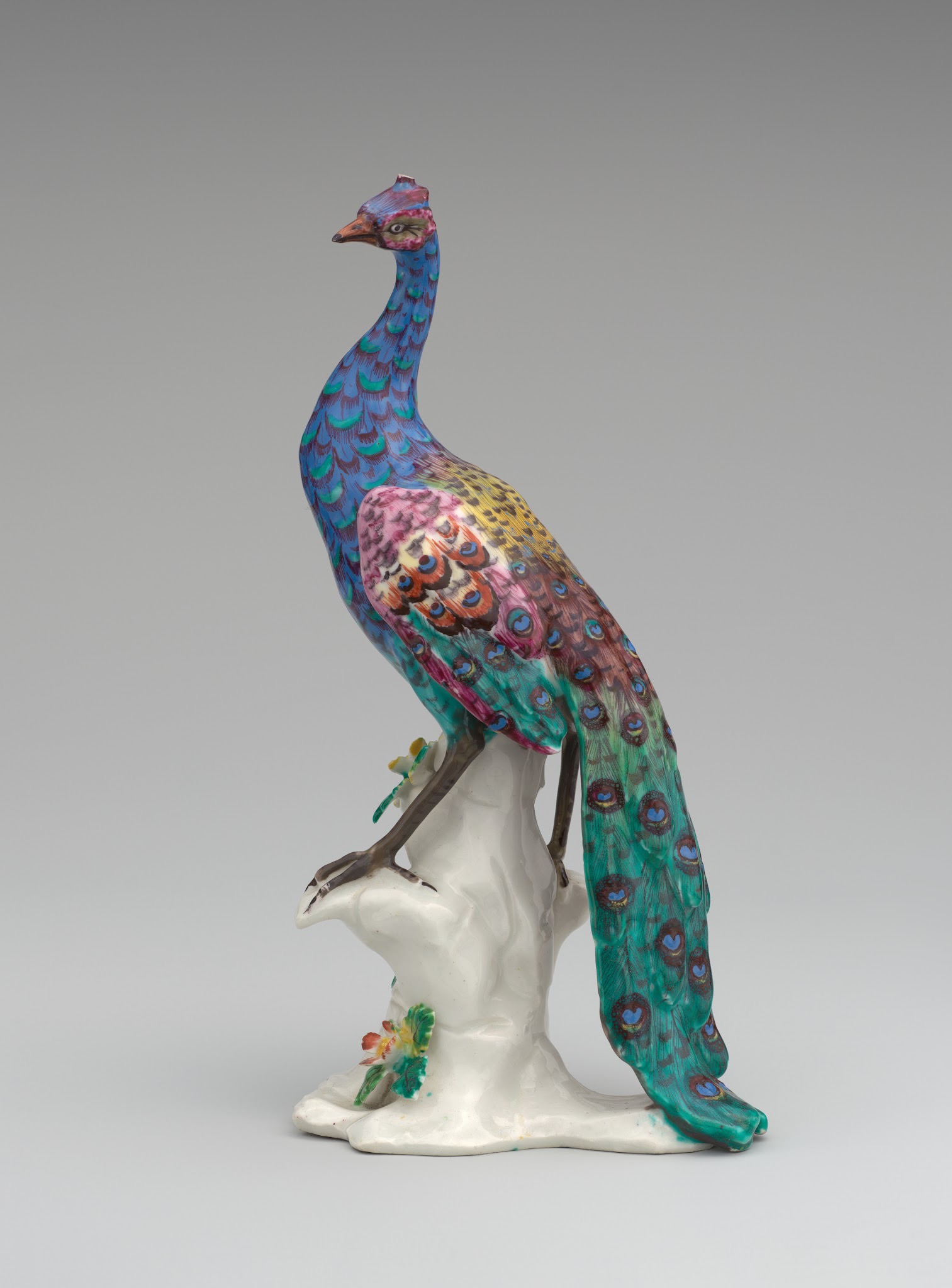
Figure 3. Bow Porcelain Factory, Peacock (one of a pair) and Peahen (one of a pair), ca. 1760. Soft-paste porcelain, 18.1 cm and 15.9 cm high. Metropolitan Museum of Art, New York, Gift of Irwin Untermyer, 1964 (64.101.726, 64.101.727). The catalog tags the figure at left “Peacocks” and the figure at right “Birds.”
Table 2. Metropolitan Museum objects whose titles do not use “peacock,” with the male counterpart in the Bow pair for comparison
| Accession no. | Title | Date | Subject tags |
|---|---|---|---|
| 1995.186 | Bian Lu, Peahen and Hibiscus | Mid-14th century | Peacocks; Flowers |
| 64.101.727 | Bow Porcelain Factory, Peahen (one of a pair) | ca. 1760 | Birds |
| 64.101.726 | Bow Porcelain Factory, Peacock (one of a pair) | ca. 1760 | Peacocks |
| 2015.500.1.29 | Dish with peafowls and peonies | Early 15th century | Birds; Peacocks; Flowers |
| 2015.370 | Plate with peafowl | ca. 1825 | Birds |
| 37.146.2 | Toshiyoshi, Peafowl Drawing for Metalwork | 19th century | None |
Source: Metropolitan Museum of Art (2026).
A second porcelain pair carries the convention further. The Chelsea Porcelain Manufactory modeled two large peafowl around 1755–58, and the Met titles both of them Peacock (one of a pair) and tags both “Peacocks” (Metropolitan Museum of Art n.d.-c, n.d.-d). The catalog entry reports that the coloration of the two porcelain birds is very similar, that a peahen would normally carry much more muted feathers and would stand notably smaller than the male, and that ornithological accuracy does not appear to have concerned the modeler, whose enamels evoke the iridescence of a male peacock. The same entry calls one figure the other’s mate and records that the modeler “clearly conceived the two peacocks as a pair” (Metropolitan Museum of Art n.d.-d). Where the Bow pair gave the hen a title and withheld the tag, the Chelsea pair dispenses with the hen altogether. The museum supplies the peacock a mate, and the mate is another peacock.
The lexical record
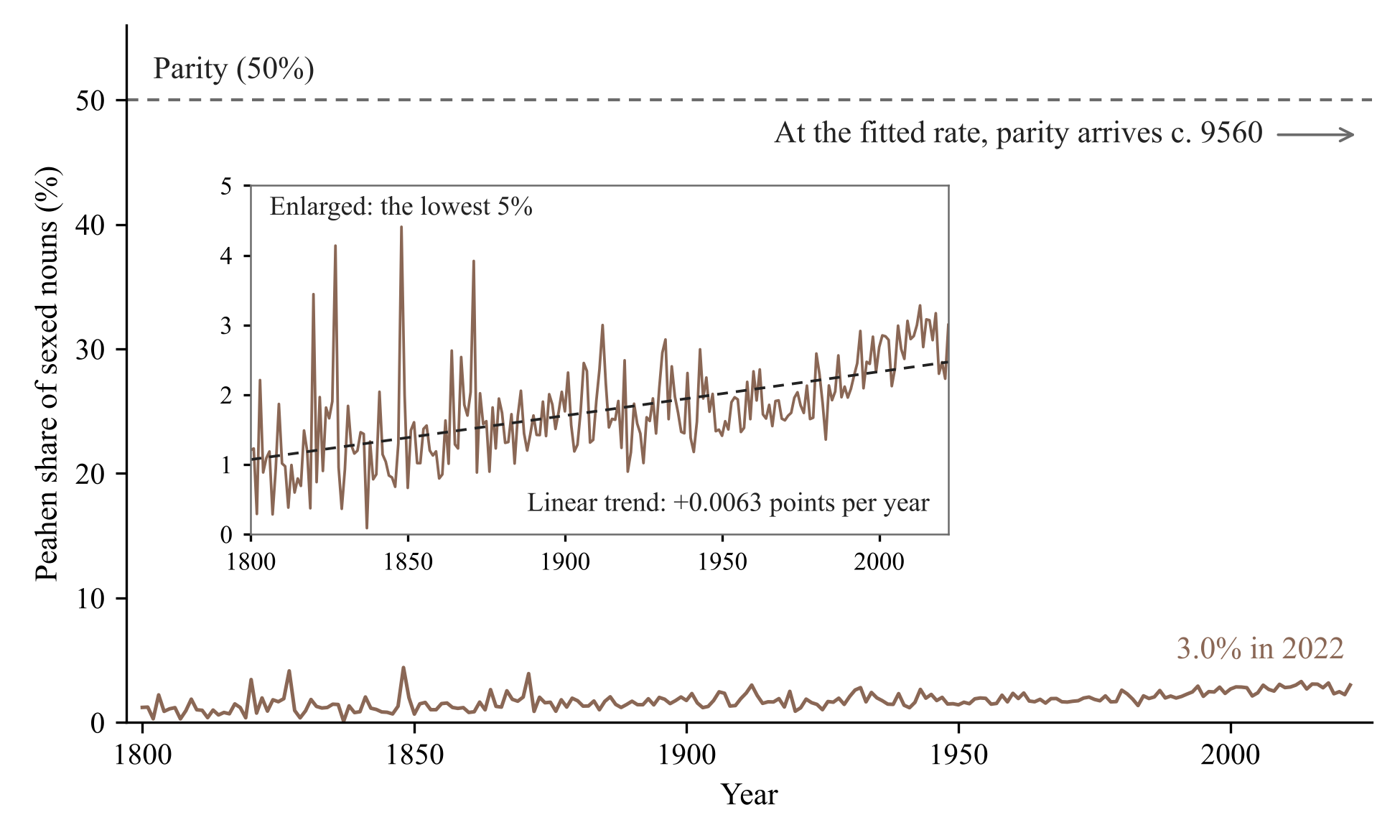
English print shows the same imbalance in normalized lexical frequency. Across 1800–2022, the sums of annual normalized frequencies yield a 57-to-1 ratio for “peacock” and “peacocks” over “peahen” and “peahens,” and a 39-to-1 ratio over “peafowl.” The peahen share of sexed peafowl nouns rose from 1.3% in 1800–1849 to 2.8% in 2000–2022 (fig. 4). A straight line fitted to the annual shares rises by 0.0063 percentage points per year. Extend that line far past the data and lexical parity arrives around the year 9560. A line fitted only to the most recent 50 years reaches the same destination around 4055. Neither projection models how languages change. I report both estimates in the spirit of optimism.
Control species
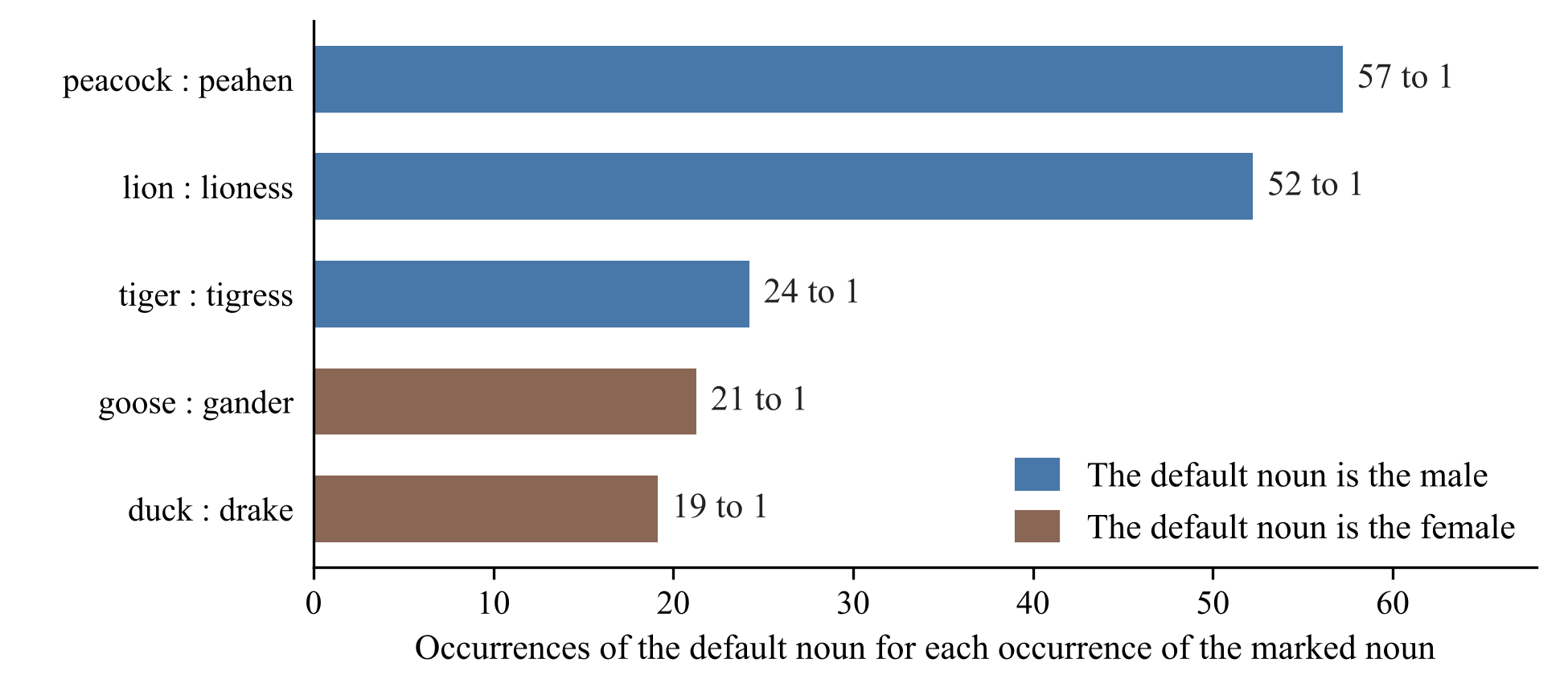
The 57-to-1 ratio looks like this paper’s strongest number. It is the least distinctive. Under the same query, “lion” and “lions” outnumber “lioness” and “lionesses” 52 to 1, and “tiger” outnumbers “tigress” 24 to 1 (fig. 5). The pattern holds when the female is the default: “goose” and “geese” outnumber “gander” and “ganders” 21 to 1, and “duck” outnumbers “drake” 19 to 1. The drake is the ornamented sex, with the green head and the curled tail, and English still files him under his mate. A lopsided ratio therefore measures which noun is unmarked. It does not measure which sex is conspicuous, and the lexical record cannot by itself show that the showier sex takes the noun.
The archives behave differently (table 3; fig. 6). Both can name a female when they choose to. iSpot indexes 950 ads under “Cows” and 233 under “Bulls.” It files chickens under the neutral “Chickens” (223 ads) and keeps a separate category for the male, “Rooster” (40 ads), with none for the hen. The Met tags 727 objects “Cows” and 645 “Bulls,” and it sexes its chickens in both directions: “Roosters” on 411 objects, “Chickens” on 181, and “Hens” on 4. The museum’s rooster outnumbers its hen about 100 to 1.
Table 3. Categories for four species in two archives, by the sex coding of the category noun
| Species | Archive | Male-coded | Female-coded | Neutral |
|---|---|---|---|---|
| Peafowl | iSpot.tv | Peacocks (26) | None | None |
| Peafowl | Met | Peacocks (467) | None | None |
| Chickens | iSpot.tv | Rooster (40) | None | Chickens (223) |
| Chickens | Met | Roosters (411) | Hens (4) | Chickens (181) |
| Cattle | iSpot.tv | Bulls (233) | Cows (950) | None |
| Cattle | Met | Bulls (645) | Cows (727) | Cattle (2) |
| Lions | iSpot.tv | None | None | Lions (173) |
| Lions | Met | None | None | Lions (2,013) |
Sources: iSpot.tv (n.d.-a), nationally aired ads per category; Metropolitan Museum of Art (2026), objects per subject tag. “None” means that the archive has no such category.
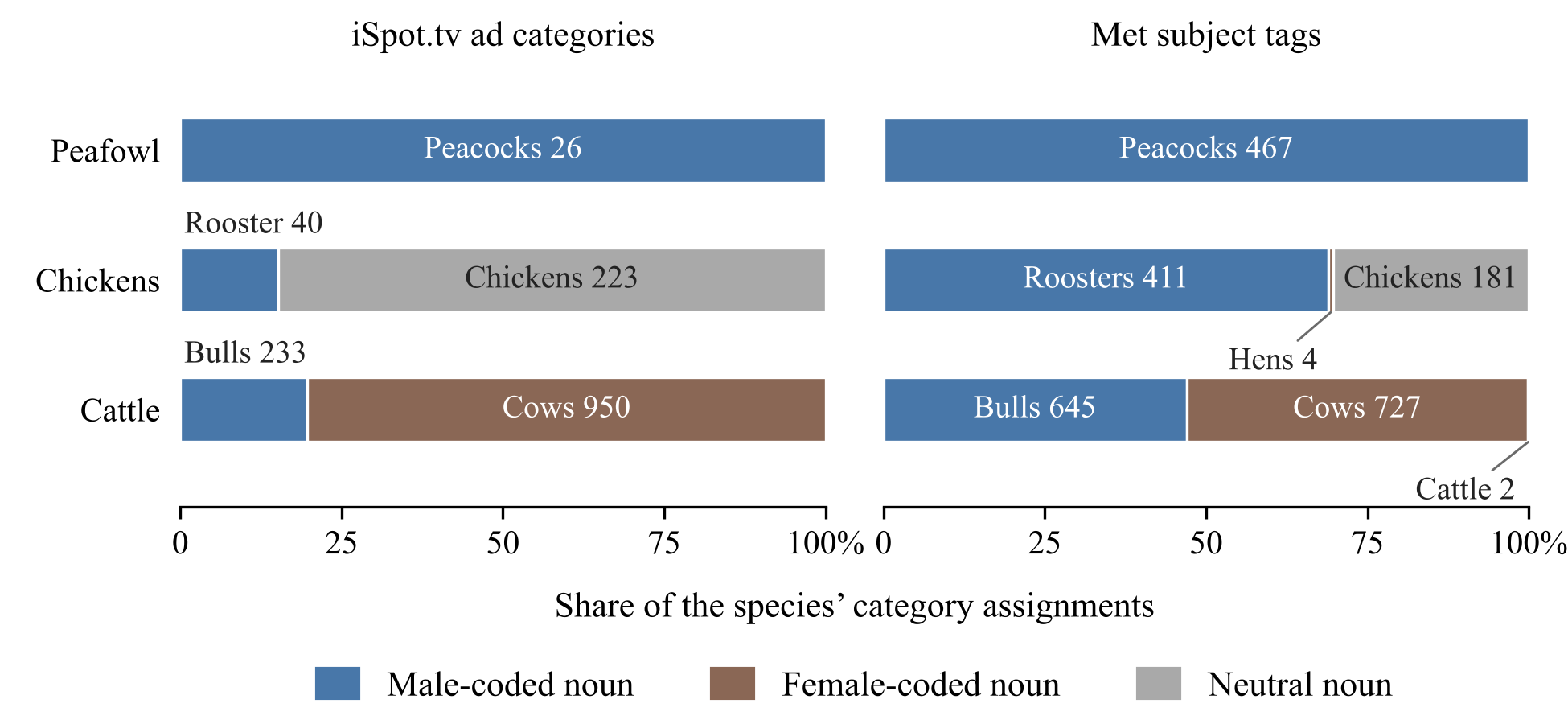
Read together, the controls divide the finding in two. Words follow markedness, and markedness can favor either sex. Images follow what the animal is for. Cattle are for milk, so the cow has a category of her own and, on television, four times the bull’s ads. Chickens are for dinner on television, where the neutral noun suffices, and for ornament in the museum, where the rooster takes over. Peafowl are for looking at in both places. They are the only species in the table whose sole category in both archives is a sex-specific male noun, and the only one whose female can enter a catalog only under the male’s name or as a generic bird. The peacock’s dominance in print is ordinary. His monopoly on the archive is not.
Case Studies
From NBC to Peacock
NBC provides the strongest historical case because its selection criterion appears in the company’s own account. NBCUniversal states that the peacock “first appeared in 1956 to announce the arrival of color television,” with 11 brightly colored plumes and the catchphrase “in living color” (NBCUniversal 2026). The emblem did not acquire its chromatic function by accident. NBC chose a peacock because the male phenotype could perform the commercial argument for color television at a glance.
Steve Baker’s Picturing the Beast (2001) treats animal images as cultural representations through which people communicate values and identities, including in popular and political symbolism. NBC’s peacock belongs to that visual economy: the bird identifies a television network, not a random member of Pavo cristatus. What appears to be a species emblem is also a design decision that recruits the male phenotype for a human commercial purpose.
That decision converted sexual dimorphism into corporate infrastructure. The adult male’s train offered what early color broadcasting needed to dramatize: saturated color, iridescent contrast, symmetry, and immediate novelty. A peahen could have represented the species just as accurately, but accuracy was not the design problem. The design problem was demonstrating color, and the female phenotype failed a job description written around conspicuous ornament before a bird ever entered the interview room.
NBC later formalized the preference. In 1977 the company’s corporate planning department found that the “in living color” icon “had become an enduring symbol of the network,” which led to its use as a logo in 1979. In 1986 the designer Steff Geissbühler reduced the bird to six plumes, one for each of NBC’s business divisions (NBCUniversal 2026; fig. 7). Color television became ordinary; male peafowl ornament remained institutionalized.
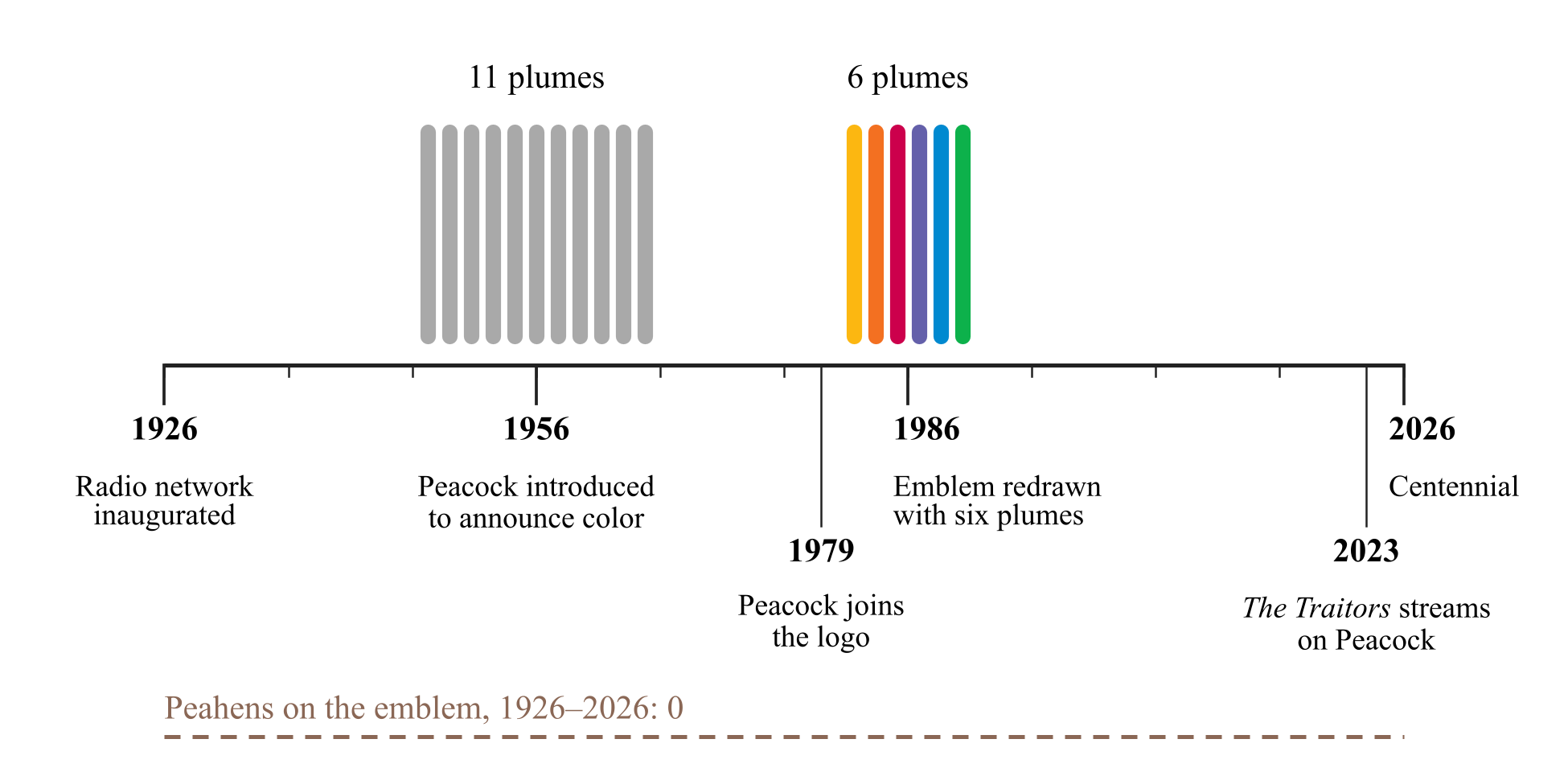
The process resembles a self-reinforcing labor market. A conspicuous male trait wins the initial role because it fits a visual requirement. Repetition makes the trait synonymous with the brand, and brand recognition becomes the rationale for continued use. NBCUniversal’s streaming service now carries the bird’s name. That service distributes the American edition of The Traitors (Peacock n.d.), and it supplied 5 of the 20 visible ads in the iSpot category (table S1). By the time a symbol reaches this stage, the original sex bias no longer appears as a decision. It appears as tradition.
Fashion and the chromatic selection problem
Fashion reproduces the same selection with unusual clarity because the industry can choose among motif, color, texture, and literal feather. The Metropolitan Museum describes a 1910 evening dress by Weeks, a little-known Parisian house, whose peacock embroidery uses metallic threads that “add a shimmery quality to the bodice” (Metropolitan Museum of Art n.d.-b). Replacing the male bird with the female would change the palette, the surface, and the argument of the dress.
Liberty & Co.’s evening coat of 1910–15 uses Arthur Silver’s “Hera,” which the Met calls Liberty’s “iconic peacock textile,” and the coat’s changeante silk “mirrors the iridescence of peacock feathers” (Metropolitan Museum of Art n.d.-a). The attribution is less settled than the motif: the Museum of Domestic Design and Architecture records an argument that Christopher Dresser, not Silver, designed the pattern (Museum of Domestic Design and Architecture n.d.). The portable feature is the sexually dimorphic ornament of the male bird, named for a goddess.
Lady Curzon’s Peacock Dress makes the point at monumental scale. Jean-Philippe Worth of the House of Worth designed the gown, and the workshop of Kishan Chand in India embroidered its fabric in gold and silver zardozi with applied green beetle-wing cases that form overlapping peacock feathers. Lady Curzon wore it at the Delhi Durbar State Ball on January 6, 1903 (National Trust n.d.). The ball took place in the Diwan-i-Khas, the chamber that once held the Mughal Peacock Throne, and the National Trust suggests that the design may have referred to it (National Trust n.d.). The dress therefore cites two displays at once, a male bird’s and an emperor’s. Scholarship reads the gown as imperial spectacle and as a statement of British power in India (Thomas 2007; Onken 2022). Its formal vocabulary comes from the eyespot and iridescence of the male train, and its iridescence comes from beetles. The garment placed a vicereine inside the sexual ornament of a male bird, rendered by Indian embroiderers whose names the gown’s fame rarely carries.
The gender crossing sharpens the peahen’s exclusion. After the Great Masculine Renunciation (Flügel 1930), Western fashion invited women to consume, wear, and embody peacock ornament while bypassing the female of the species from which that ornament came. A woman could become more visible by borrowing the display of a male bird whose own female remained irrelevant to the transaction. When menswear reclaimed color in the 1960s, a market researcher named the change the Peacock Revolution (Hill 2018). Ornament changed hands again, and the bird that lent its name was still the male.
Feather garments make the appropriation material. Keefe (2016) documents nineteenth-century pelerines constructed from patterned arrangements of peacock, pheasant, and other bird feathers. In these objects plumage stops representing the bird and becomes raw material, and the hierarchy persists: the feathers worth preserving are the ones that produce chromatic distinction.
Discussion
Chromatic patriarchy
The evidence suggests a mechanism I call chromatic patriarchy: a representational practice in which a visually oriented institution selects a sexually dimorphic species through the sex whose conspicuous traits suit its purpose, then allows that sex to stand for the whole species. The term describes cultural selection, not peafowl social organization. A stricter reviewer might prefer “androcentrism,” since no peacock rules anything. I retain “patriarchy” because the noun “peacock” governs these particular records: the advertising category, the museum tag, the corporate logo, and the dictionary’s broad sense. The records document the mechanism in selected settings; they cannot establish its prevalence across visual culture.
The phrase acknowledges Haraway’s “Teddy Bear Patriarchy” (1984–85). The displays she examined manufactured a credible picture of natural order by selecting and arranging particular animals. These cases concern a later step, in which an animal’s image becomes a searchable category and a corporate identity. “Chromatic” names the pull of visible ornament at that step. Haraway never wrote about peafowl, and not every image of an ornamented male travels this route.
The control species set the term’s limits. Chromatic patriarchy is a claim about images and the categories built on them. It is not a claim about vocabulary, where the goose and the duck hold the default and the drake, for all his ornament, takes the marked noun. Nor does it describe every archive: where an animal is valued for a product, the producer gets the category, and the cow outnumbers the bull. The mechanism operates where the animal is valued for being seen. In that market the ornamented sex supplies the image, the image supplies the category, and the category, in the peacock’s case, borrows a noun that was already his.
The peahen as casting director
Sexual selection and commercial selection reward overlapping traits. In courtship, the peahen evaluates the display. Advertising also competes for attention, and a trait shaped to attract gaze enters that market with an evolutionary head start. Zahavi (1975) argued that the train persuades because it is a handicap that only a fit male can afford. Veblen (1899) had said much the same of the silver spoon. An advertiser who fills a mansion with peacocks cites both. In this sense the advertising industry occupies the peahen’s position: it is the evaluating eye, and it chooses the most ornamented male.
The comparison flatters the industry less than it first appears to. The evidence that peahens prefer more elaborate trains is mixed (Petrie et al. 1991; Takahashi et al. 2008; Dakin and Montgomerie 2011). The institutional taxonomies and visual branding examined here consistently privilege the male-coded peafowl. If the field studies are right, human institutions now select for train elaboration more consistently than the species that evolved it. O’Connor (1961), who kept about 40 peafowl in Georgia, reported the same indifference from her yard: while the cock displayed, the hen went on looking for bugs.
The inversion noted in the Background now resolves. In Mulvey’s scheme the one who looks holds the power, and by that measure the peahen is the privileged party: the peacock is the spectacle, and she is the audience. She holds that seat only in the lek. In the archive, human institutions have taken it. The peahen is displaced twice, first as an image, because she is not the ornament, and then as a viewer, because advertisers, curators, and networks now do the choosing. A glass ceiling and a front-row seat are compatible when someone else occupies the seat.
The avian glass ceiling
The metaphor of a glass ceiling usually describes a barrier that institutions keep invisible by presenting neutral criteria for advancement. Peafowl provide an almost embarrassingly literal version. Television need not announce a preference for male birds. It can require color, recognizability, luxury, theatricality, and a five-foot iridescent train, and then express surprise when the applicant pool at the top consists entirely of peacocks. A casting notice built on those requirements remains formally open to all peafowl, but its qualifications are not sex-neutral in any meaningful biological sense.
The category labels record the endpoint of that process. iSpot’s category reads “Peacocks,” with no female subtype beneath it (iSpot.tv n.d.-e). The Met’s vocabulary offers a peahen “Peacocks” or “Birds.” Taxonomy follows visibility, and the sex that dominates the image also supplies the noun. The female bird contributes little to the visual archive because her commercially useful distinction lies in not resembling the peacock. She is biologically successful and culturally unemployed.
Limitations
The television p value has two defects, and the null comes first. There is no reason to expect an advertising index to choose “peacock” and “peahen” at even odds. The imposed 50:50 baseline demonstrates a statistical procedure; it models nothing about the vendor. Independence then fails as well: all 26 advertisements inherit a single category decision from one vendor (Hurlbert 1984). The visible ads cluster, with three Aetna “Zoo” variants, two Jeep “Earth Odyssey” versions, and five Peacock TV spots. The streaming-service ads may carry the tag for their brand rather than a bird, and six more ads sit behind registration. The supposed trials are not trials. I concede both points. The p value remains beautiful. The American Statistical Association cautions that p values establish neither the truth of a hypothesis nor the importance of a result (Wasserstein and Lazar 2016), and the parachute review shows how impeccable arithmetic survives absurd assumptions (Smith and Pell 2003). The Met’s missing category and its named objects carry more weight than either tail area.
The television analysis measures sex-coded metadata, not the sex of the birds on screen. It involved no necropsies, genetic tests, or frame-by-frame veterinary examination of every bird in every ad, and an advertising metadata vendor does not operate as an ornithological authority. A frame-level coding of all 26 ads would show whether any peahen appears on screen under the “Peacocks” label, as one does in the Met’s catalog. The Traitors observation shares this limitation and adds its own: it was unsystematic, uncounted, and made by a single viewer who was also enjoying the show.
The 50:50 premise describes no known population of birds, advertisements, catalog records, or curatorial decisions. Wild and captive sex ratios need not be equal, and production companies do not sample birds randomly. Even curator-assigned titles are not independent: departments share vocabularies and precedents, and one peahen receives her own title only as the female half of a porcelain pair. Read both sets of binomial calculations as demonstrations. The asymmetries they dramatize are the findings.
The museum and lexical corpora carry their own biases. The Met’s catalog reflects generations of acquisition and cataloging practice, and its titles sometimes use “peacock” for objects named after the bird. The Google Books corpus contains OCR errors, uneven metadata, ambiguous common nouns, and serially related annual frequencies. The parity estimates extend a fitted line beyond its evidentiary horizon, ignoring linguistic change, nonlinear dynamics, and the possibility that English will stop printing books before the year 9560. The control ratios inherit that noise: “duck” is also a verb, “drake” can be a mayfly, and I left “hen,” “cock,” “cow,” and “bull” out of the lexical tests because they carry additional meanings. I chose the comparison species purposively rather than sampling them. The archive comparison counts categories as each institution reports them; it does not establish correct identification or biological sex in the pictures, and one object may carry several tags. Fashion objects reflect survival and curatorial priorities, so they serve as cases rather than frequency estimates. The sources converge on a narrower observation: in the documented practices examined here, male peafowl ornament travels readily through branding, cataloging, and dress while female-coded recognition remains scarce. A claim about prevalence would require a prespecified sampling frame, frame-level coding, and agreement checks between coders. These sources document particular naming practices and visual examples; they do not establish how frequently peahens appear across all media.
Conclusion
The peahen does not suffer from an absence of biological legitimacy. She suffers from a branding problem. Her species entered modern visual culture through a competition whose decisive criteria (color, spectacle, iridescence, fan geometry, and immediate recognizability) closely track the male’s sexually selected phenotype. Once those criteria hardened into convention, the peacock became both the male bird and the public image of peafowl as such.
The archives make the substitution inspectable. iSpot indexes 26 nationally aired ads under “Peacocks” and offers no female-coded category. The Met tags 467 objects “Peacocks,” tags none “Peahens,” and files an explicitly identified porcelain peahen under “Birds” while her mate receives a tag of his own. English print favors the male noun 57 to 1, which the controls show to be ordinary markedness: the lion does nearly as well, and the goose and duck do likewise in the other direction. The institutional categories are where peafowl warrant special attention. Both archives can name the cow; neither supplies the peahen a sex-specific category. NBC’s history explains the commercial usefulness of the male display, and fashion objects show the same ornamental preference in selected garments.
The conclusion extends beyond one bird, within limits the controls make clear. Conspicuousness does not automatically determine the species noun; the drake never acquired the duck’s default name. In these particular visual and cataloging cases, however, male peafowl ornament becomes an expedient public emblem, and that emblem can pass for neutral identification. The pattern remains unmeasured across television imagery as a whole. It surfaced, all the same, in a reality series about deception, filmed at a Scottish castle and streamed on a service named for a male bird, in which this viewer could find no peahen. The avian glass ceiling is transparent, brightly colored, and decorated with eyespots.
Acknowledgments
The author wishes to thank the peafowl of Ardross Castle for their screen time and the peahens of Ardross Castle, if any, for their patience.
Funding
This research received no external funding.
Competing Interests
The author declares no competing interests.
Author Contributions
Brandon Jones conceived the study, made the exploratory observation, directed the analyses, and wrote the paper.
Ethics Statement
This study involved no human participants and no live animals. No peafowl were handled, observed in person, or consulted. All observations of living peafowl took place through television.
Use of Generative AI
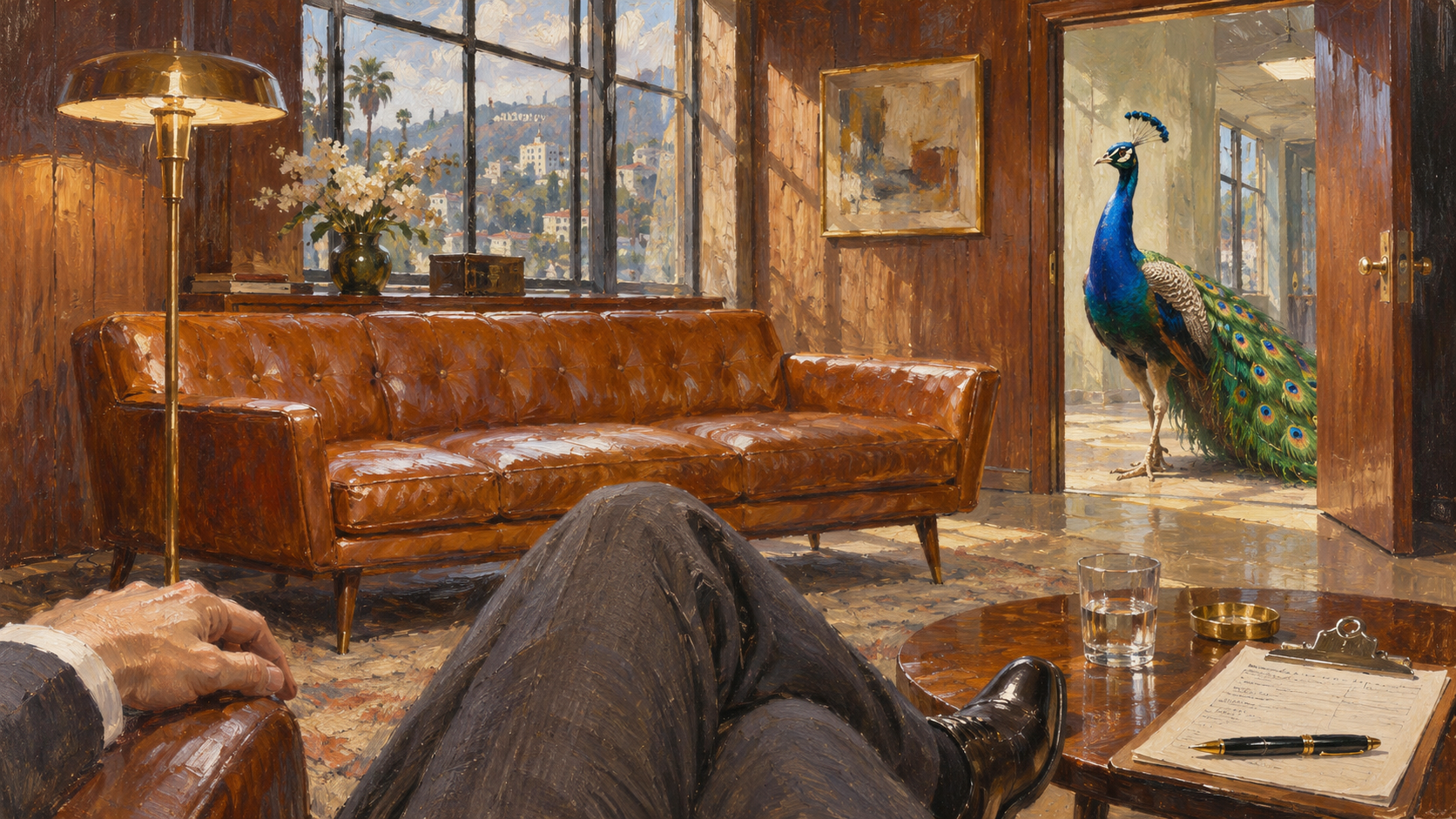
The author used generative AI tools, including Anthropic’s Claude, for research assistance, data retrieval and analysis, statistical verification, figure preparation, and drafting and editing. The featured editorial painting was generated with an AI image-generation tool and does not depict an actual casting session. The author directed the study and takes responsibility for its content.
Data and Materials Availability
The iSpot.tv category page is publicly accessible (iSpot.tv n.d.-e); table S1 lists the 20 ads it displayed on October 29, 2026, and again on November 13, 2026. The Met Open Access dataset is publicly available (Metropolitan Museum of Art 2026); this analysis used commit d31d26f. The Google Books Ngram query parameters appear in Materials and Methods. The model-conditional binomial calculations are fully specified by the observed counts, stipulated null probability, exact-interval method, and effect-size definition given above. Supplementary Data S2 freezes the 223 annual normalized-frequency observations for all 21 Ngram queries, records the five exact retrieval URLs, and provides formula-based checks of the word ratios and extrapolations. The workbook captures the English corpus as returned on November 13, 2026; future live queries may differ when Google updates its corpus.
References
Askew, Graham N. 2014. “The Elaborate Plumage in Peacocks Is Not Such a Drag.” Journal of Experimental Biology 217 (18): 3237–41. https://doi.org/10.1242/jeb.107474.
Baker, Steve. 2001. Picturing the Beast: Animals, Identity, and Representation. University of Illinois Press. First published 1993 by Manchester University Press. https://www.press.uillinois.edu/books/?id=p070303.
Beauvoir, Simone de. (1949) 2011. The Second Sex. Translated by Constance Borde and Sheila Malovany-Chevallier. Vintage Books.
Berger, John. 1972. Ways of Seeing. British Broadcasting Corporation and Penguin Books.
Bryan, Melanie. 2026. “Your Parents Could Have Bought Ardross Castle—Home of The Traitors—for Just £70,000.” Country Life, October 1, 2026. https://www.countrylife.co.uk/architecture/where-is-the-traitors-filmed-inside-a-storied-scottish-castle-that-was-sold-via-the-pages-of-country-life-three-times.
The Celebrity Traitors. 2025–. Hosted by Claudia Winkleman. Produced by Studio Lambert. BBC One.
Chris, Cynthia. 2006. Watching Wildlife. University of Minnesota Press. https://www.upress.umn.edu/9780816645473/watching-wildlife/.
Clopper, C. J., and E. S. Pearson. 1934. “The Use of Confidence or Fiducial Limits Illustrated in the Case of the Binomial.” Biometrika 26 (4): 404–13. https://doi.org/10.1093/biomet/26.4.404.
Cohen, Jacob. 1988. Statistical Power Analysis for the Behavioral Sciences. 2nd ed. Lawrence Erlbaum Associates.
Cooper, Natalie, Alexander L. Bond, Joshua L. Davis, Roberto Portela Miguez, Louise Tomsett, and Kristofer M. Helgen. 2019. “Sex Biases in Bird and Mammal Natural History Collections.” Proceedings of the Royal Society B: Biological Sciences 286 (1913): 20192025. https://doi.org/10.1098/rspb.2019.2025.
Cornell Lab of Ornithology. n.d. “Indian Peafowl Identification.” All About Birds. Accessed October 29, 2026. https://www.allaboutbirds.org/guide/Indian_Peafowl/id.
Dakin, Roslyn, Owen McCrossan, James F. Hare, Robert Montgomerie, and Suzanne Amador Kane. 2016. “Biomechanics of the Peacock’s Display: How Feather Structure and Resonance Influence Multimodal Signaling.” PLOS ONE 11 (4): e0152759. https://doi.org/10.1371/journal.pone.0152759.
Dakin, Roslyn, and Robert Montgomerie. 2011. “Peahens Prefer Peacocks Displaying More Eyespots, but Rarely.” Animal Behaviour 82 (1): 21–28. https://doi.org/10.1016/j.anbehav.2011.03.016.
Darwin, Charles. 1860. “To Asa Gray, 3 April [1860].” Letter no. 2743. Darwin Correspondence Project. Accessed October 29, 2026. https://www.darwinproject.ac.uk/entry-2743.
Darwin, Charles. 1871. The Descent of Man, and Selection in Relation to Sex. 2 vols. John Murray.
Denver Zoo. n.d. “Indian Peafowl (Pavo cristatus).” Fact sheet. Accessed October 29, 2026. https://www.denverzoo.org/wp-content/uploads/2018/09/Indian-Peafowl.pdf.
Flügel, J. C. 1930. The Psychology of Clothes. Hogarth Press.
Google. n.d. “Google Books Ngram Viewer.” Query terms peacock, peacocks, peahen, peahens, and peafowl, and the control pairs lion and lioness, tiger and tigress, goose and gander, and duck and drake with their plurals; English corpus; 1800–2022; case-sensitive; smoothing 0. Accessed November 13, 2026. https://books.google.com/ngrams/.
Haraway, Donna. 1984–85. “Teddy Bear Patriarchy: Taxidermy in the Garden of Eden, New York City, 1908–36.” Social Text, no. 11 (Winter): 20–64. https://doi.org/10.2307/466593.
Hill, Daniel Delis. 2018. Peacock Revolution: American Masculine Identity and Dress in the Sixties and Seventies. Bloomsbury Visual Arts.
Hilton. n.d. “Peacock Alley Fact Sheet.” Stories from Hilton. Accessed November 13, 2026. https://stories.hilton.com/food-beverage/peacock-alley-fact-sheet.
Hofstadter, Douglas R. 1985. “A Person Paper on Purity in Language.” In Metamagical Themas: Questing for the Essence of Mind and Pattern. Basic Books.
Hunt, Elle. 2025. “Secret Rooms, Stephen Fry, Winkleman’s Horse Impression: The Truth About the Traitors Castle.” Guardian, October 8, 2025. https://www.theguardian.com/tv-and-radio/2025/oct/08/secret-rooms-stephen-fry-winkleman-horse-impression-celebrity-traitors-castle-bbc.
Hurlbert, Stuart H. 1984. “Pseudoreplication and the Design of Ecological Field Experiments.” Ecological Monographs 54 (2): 187–211. https://doi.org/10.2307/1942661.
iSpot.tv. n.d.-a. Animal category pages for bulls, chickens, cows, lions, and roosters, and site search results for “peahen,” “peahens,” and “peafowl.” Accessed November 13, 2026. https://www.ispot.tv/.
iSpot.tv. n.d.-b. “Arby’s Sandwich Legends TV Spot, ‘Therapy Peacock.’” Accessed October 29, 2026. https://www.ispot.tv/ad/wh5X/arbys-sandwich-legends-therapy-peacock.
iSpot.tv. n.d.-c. “Autotrader TV Spot, ‘Price Advisor’ Featuring Andy Cohen.” Accessed October 29, 2026. https://www.ispot.tv/ad/ddOA/autotrader-com-price-advisor-featuring-andy-cohen.
iSpot.tv. n.d.-d. “McDonald’s Dollar Menu TV Spot, ‘Smart Money’ Featuring Rashid Byrd.” Accessed October 29, 2026. https://www.ispot.tv/ad/7Be0/mcdonalds-dollar-menu-smart-money-featuring-rashid-byrd.
iSpot.tv. n.d.-e. “Peacocks TV Commercials.” Accessed October 29, 2026. https://www.ispot.tv/topic/animal/7lj/peacocks.
iSpot.tv. n.d.-f. “Peacock TV TV Spot, ‘Peacock Hatching.’” Accessed October 29, 2026. https://www.ispot.tv/ad/ZMWk/peacock-tv-peacock-hatching.
Keefe, Anna Rose. 2016. “Forgotten Fashions: Feather Pelerines of the Nineteenth Century.” Master’s thesis, University of Rhode Island. https://doi.org/10.23860/thesis-keefe-anna-2016.
Library of Congress. n.d. “Introduction.” The National Broadcasting Company at the Library of Congress. Research Guides. Accessed November 12, 2026. https://guides.loc.gov/nbc.
Mattel. n.d. “Enchantimals Patter Peacock Doll.” Accessed October 29, 2026. https://shop.mattel.com/en-ca/products/enchantimals-patter-peacock-doll-fxm74-en-ca.
McCabe, Janice, Emily Fairchild, Liz Grauerholz, Bernice A. Pescosolido, and Daniel Tope. 2011. “Gender in Twentieth-Century Children’s Books: Patterns of Disparity in Titles and Central Characters.” Gender & Society 25 (2): 197–226. https://doi.org/10.1177/0891243211398358.
Merriam-Webster. n.d.-a. “Peacock.” Merriam-Webster.com Dictionary. Accessed October 29, 2026. https://www.merriam-webster.com/dictionary/peacock.
Merriam-Webster. n.d.-b. “Peafowl.” Merriam-Webster.com Dictionary. Accessed October 29, 2026. https://www.merriam-webster.com/dictionary/peafowl.
Merriam-Webster. n.d.-c. “Peahen.” Merriam-Webster.com Dictionary. Accessed October 29, 2026. https://www.merriam-webster.com/dictionary/peahen.
Metropolitan Museum of Art. 2026. “MetObjects.csv.” The Met Open Access dataset. GitHub. Downloaded November 13, 2026, at commit d31d26f. https://github.com/metmuseum/openaccess.
Metropolitan Museum of Art. n.d.-a. Evening Coat. Liberty & Co., 1910–15; textile designed by Arthur Silver. Accession no. 2009.300.551. Accessed October 29, 2026. https://www.metmuseum.org/art/collection/search/159095.
Metropolitan Museum of Art. n.d.-b. Evening Dress. Weeks, 1910. Accession no. 2009.300.293. Accessed October 29, 2026. https://www.metmuseum.org/art/collection/search/157810.
Metropolitan Museum of Art. n.d.-c. Peacock (one of a pair). Chelsea Porcelain Manufactory, ca. 1755–58. Accession no. 64.101.480. Accessed November 13, 2026. https://www.metmuseum.org/art/collection/search/203350.
Metropolitan Museum of Art. n.d.-d. Peacock (one of a pair). Chelsea Porcelain Manufactory, ca. 1755–58. Accession no. 64.101.481. Accessed November 13, 2026. https://www.metmuseum.org/art/collection/search/238557.
Michel, Jean-Baptiste, Yuan Kui Shen, Aviva Presser Aiden, et al. 2011. “Quantitative Analysis of Culture Using Millions of Digitized Books.” Science 331 (6014): 176–82. https://doi.org/10.1126/science.1199644.
Milam, Erika Lorraine. 2010. Looking for a Few Good Males: Female Choice in Evolutionary Biology. Johns Hopkins University Press.
Mulvey, Laura. 1975. “Visual Pleasure and Narrative Cinema.” Screen 16 (3): 6–18. https://doi.org/10.1093/screen/16.3.6.
Museum of Domestic Design and Architecture. n.d. “Hera.” Middlesex University. Accessed November 13, 2026. https://moda.mdx.ac.uk/?p=2766.
National Trust. n.d. “The Peacock Dress, 107881.” National Trust Collections. Designed by Jean-Philippe Worth; embroidery by the workshop of Kishan Chand. Accessed October 29, 2026. https://www.nationaltrustcollections.org.uk/object/107881.
NBCUniversal. 2026. “Inside 100 Years of the NBC Logo.” May 4, 2026. https://www.nbcuniversal.com/article/inside-100-years-nbc-logo.
NBCUniversal. n.d. “1950.” Our History. Accessed November 12, 2026. https://www.nbcuniversal.com/history/1950.
O’Connor, Flannery. 1961. “Living with a Peacock.” Holiday, September 1961. Reprinted by American Masters, PBS, March 4, 2021. https://www.pbs.org/wnet/americanmasters/living-with-a-peacock-by-flannery-oconnor/17357.
Onken, Rebecca. 2022. “The Peacock Dress: The Language of British Imperialism in India, 1899–1905.” Armstrong Undergraduate Journal of History 12 (1): 61–75. https://doi.org/10.20429/aujh.2022.120104.
Peacock. n.d. “The Traitors.” Accessed October 29, 2026. https://www.peacocktv.com/stream-tv/the-traitors.
Petrie, Marion, Tim Halliday, and Carolyn Sanders. 1991. “Peahens Prefer Peacocks with Elaborate Trains.” Animal Behaviour 41 (2): 323–31. https://doi.org/10.1016/S0003-3472(05)80484-1.
Schiebinger, Londa. 1993. Nature’s Body: Gender in the Making of Modern Science. Beacon Press.
Smith, Gordon C. S., and Jill P. Pell. 2003. “Parachute Use to Prevent Death and Major Trauma Related to Gravitational Challenge: Systematic Review of Randomised Controlled Trials.” BMJ 327 (7429): 1459–61. https://doi.org/10.1136/bmj.327.7429.1459.
Smithsonian’s National Zoo and Conservation Biology Institute. n.d. “Common Peafowl.” Accessed October 29, 2026. https://nationalzoo.si.edu/animals/common-peafowl.
Takahashi, Mariko, Hiroyuki Arita, Mariko Hiraiwa-Hasegawa, and Toshikazu Hasegawa. 2008. “Peahens Do Not Prefer Peacocks with More Elaborate Trains.” Animal Behaviour 75 (4): 1209–19. https://doi.org/10.1016/j.anbehav.2007.10.004.
Tannen, Deborah. 1993. “Wears Jump Suit. Sensible Shoes. Uses Husband’s Last Name.” New York Times Magazine, June 20, 1993.
Thomas, Nicola J. 2007. “Embodying Imperial Spectacle: Dressing Lady Curzon, Vicereine of India 1899–1905.” Cultural Geographies 14 (3): 369–400. https://doi.org/10.1177/1474474007078205.
The Traitors [UK]. 2022–. Hosted by Claudia Winkleman. Produced by Studio Lambert. BBC One.
The Traitors [US]. 2023–. Hosted by Alan Cumming. Produced by Studio Lambert. Peacock.
Veblen, Thorstein. 1899. The Theory of the Leisure Class: An Economic Study of Institutions. Macmillan.
Virtanen, Pauli, Ralf Gommers, Travis E. Oliphant, et al. 2020. “SciPy 1.0: Fundamental Algorithms for Scientific Computing in Python.” Nature Methods 17 (3): 261–72. https://doi.org/10.1038/s41592-019-0686-2.
Wasserstein, Ronald L., and Nicole A. Lazar. 2016. “The ASA Statement on p-Values: Context, Process, and Purpose.” American Statistician 70 (2): 129–33. https://doi.org/10.1080/00031305.2016.1154108.
Yorzinski, Jessica L., Gail L. Patricelli, Jason S. Babcock, John M. Pearson, and Michael L. Platt. 2013. “Through Their Eyes: Selective Attention in Peahens During Courtship.” Journal of Experimental Biology 216 (16): 3035–46. https://doi.org/10.1242/jeb.087338.
Zahavi, Amotz. 1975. “Mate Selection—A Selection for a Handicap.” Journal of Theoretical Biology 53 (1): 205–14. https://doi.org/10.1016/0022-5193(75)90111-3.
Supplementary Materials
Table S1. Nationally aired U.S. television ads displayed on iSpot.tv’s “Peacocks” category page on October 29 and November 13, 2026
| No. | Advertiser | Spot title as indexed by iSpot.tv |
|---|---|---|
| 1 | Orkin | “Pool Floaties” |
| 2 | GEICO | “Nature Sounds” |
| 3 | Arby’s | Sandwich Legends, “Therapy Peacock” |
| 4 | Aetna | Medicare Advantage Plans, “Zoo: High Gear: $0 Monthly Premium” |
| 5 | Aetna | Medicare Advantage Plans, “Zoo” |
| 6 | Enchantimals | “Animal Besties” |
| 7 | Aetna | Medicare Advantage Plans, “Zoo: Benefits” |
| 8 | McDonald’s | Dollar Menu, “Smart Money” Featuring Rashid Byrd |
| 9 | San Diego Zoo Wildlife Alliance | “You Can’t Replace Wildlife Once It’s Gone” |
| 10 | Jeep | 2021 Jeep Wrangler 4xe, “Earth Odyssey” [T1] |
| 11 | ESPN | ESPN Fantasy Football, “Jeans” |
| 12 | Autotrader | “Price Advisor” Featuring Andy Cohen |
| 13 | Peacock TV | “Peacock Hatching” |
| 14 | Peacock TV | “Lo último” canción de Static & Ben El, Pitbull [Spanish] |
| 15 | Jeep | “2022: Earth Odyssey” [T1] |
| 16 | The Beaches of Fort Myers and Sanibel | “Know the Feeling: This is More Like It” |
| 17 | Peacock TV | “Cheers” Featuring Ted Danson |
| 18 | Mint Mobile | “Holidays: 3 Months of Wireless for $20: Yeti” |
| 19 | Peacock TV | “Nacido para entretener” [Spanish] |
| 20 | Peacock TV | “XFINITY Customers” Song by James Hutchinson, Adele Roberts |
Source: iSpot.tv (n.d.-e). The category lists 26 ads; the six not shown here require iSpot registration. Spot titles appear in iSpot’s order and wording.
Supplementary Data S2. Google Books Ngram annual-series replication workbook (1800–2022). The companion workbook preserves all 223 years for 21 source terms, the five exact retrieval URLs, and the formulas behind the ratios, lexical trends, and deliberately distant parity projections: Open Supplementary Data S2 (Google Books Ngram replication workbook).