Translated from the French. The original version controls.
A synthetic dialogue that NotebookLM produced from my research and that I then revised.
Episode Summary
The episode begins by restoring the Cretan career of Doménikos Theotokópoulos (El Greco), with its Byzantine icons and recognized mastery, before following his Italian years and his move to Toledo. It shows how the artist orchestrates a deliberate dialogue between disegno and colore; The Burial of the Count of Orgaz demonstrates it cleanly: a measured lower register, an incandescent upper one.
We set aside the old pathological hypotheses (astigmatism included), correct the idea of an exclusively Spanish “maturity,” and reread the work as a bridge from Byzantium to the West.
Why listen: for clarity rather than hype, and for questions rather than sweeping formulas.
Format: a host/guest conversation drawn from original research.
Chapters
- 00:01 · Introduction and historiographical frame
- 00:35 · Crete: icon, light, compressed space
- 01:16 · Italy: encounters, workshops, vocabulary
- 01:26 · Toledo: the transition to the Spanish period
- 02:49 · disegno / colore in tension (the explanation begins)
- 03:14 · The Burial of the Count of Orgaz (analysis in situ)
- 04:29 · Conclusion and ways of looking differently
Transcript
The audio is in French. What follows is a translation of its transcript.
Welcome. Today we’re diving into the world of El Greco, whose real name was Doménikos Theotokópoulos.
And we’re drawing on research, a fairly recent source, that shakes up the classic image of the artist a bit.
Absolutely.
The goal is to understand why he was almost forgotten for three centuries after his death in 1614,
and why his story needs some revisiting.
And the central idea, really, the one that changes quite a lot, is that El Greco didn’t become a painter in Europe.
Really?
No. He was already a recognized, well-paid master in Crete, before he even left, at around 27.
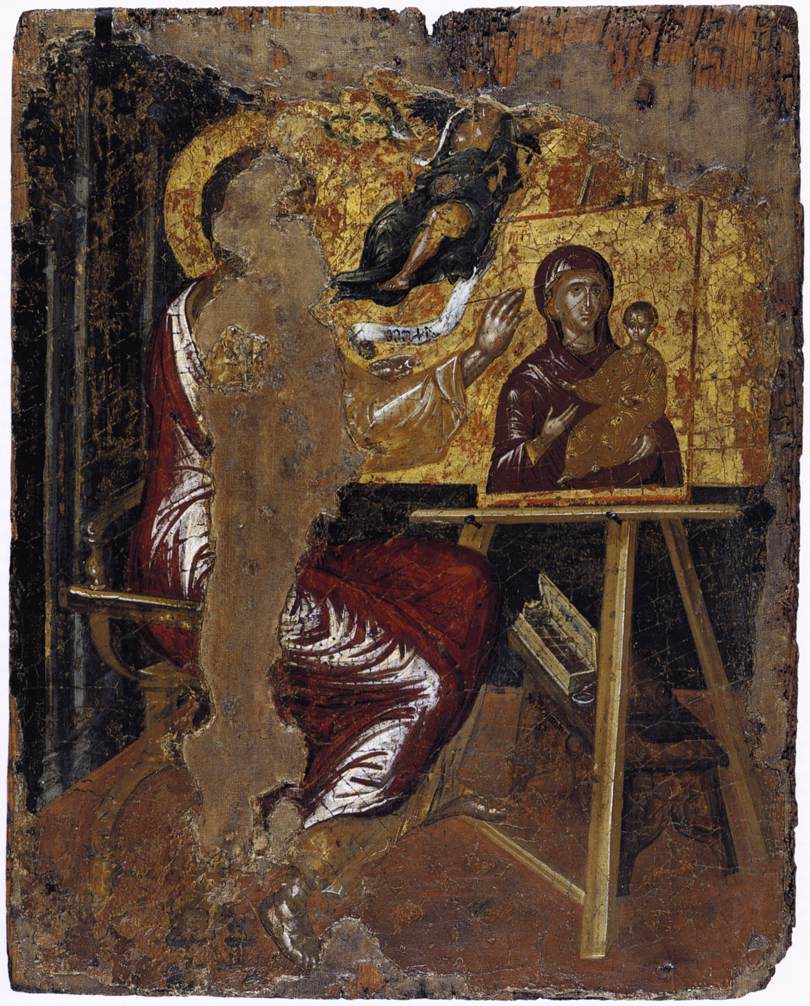
He specialized in Byzantine icons.
Okay, so an accomplished artist from the start, in a way.
Exactly. Think of works like Saint Luke Painting the Virgin and Child, or The Dormition of the Virgin.
These aren’t just trial pieces.
No, no.
This is a master’s work, in that highly codified style.
The somewhat compressed compositions, the very strong spiritual function.
And you can already see those famous highlights starting to appear.
Those light touches that give relief.
That’s what catches the eye.
It’s wild, because instinctively we mostly read him through Europe.
Well, yes.
Italy first, his admiration for Michelangelo, especially his drawings.
Apparently he even annotated his copy of Vasari’s Lives.
Yes, yes, he did.
And then, of course, Spain, Toledo.
Even if the king didn’t like his Martyrdom of Saint Maurice.
That’s right.
And after his death, a great silence for centuries.
Or worse, people tried to explain his very particular style with some rather strange stuff.
Like what?
People said he was mad, or that he was astigmatic, to justify his elongated figures.
Oh yes, I’ve heard that.
Well, there you go.
But it doesn’t hold up.
An art historian, Harold Wethey, showed clearly that in The Burial of the Count of Orgaz,
A major work?
Yes, well, the painter perfectly distinguishes the earthly figures, who have normal proportions,
from the heavenly figures, which are stretched.
And then there’s a psychologist, Stuart Anstis, who ran experiments.
Okay.
And who proved that astigmatism doesn’t distort your vision enough to make you paint like that all the time.
It isn’t possible.
Right, so we can forget those somewhat simplistic theories.
But then, that label people often stick on him, Mannerist,
late Renaissance, elongated forms, complex composition, that seems to fit him, no?
Yes.
It seems to.
But is it enough once you really take his Cretan period into account?
That’s exactly where it gets a bit stuck.
Seeing him only as a Mannerist is, how should I put it,
it’s missing his Byzantine roots.
And they’re crucial.
Okay.
He didn’t just imitate Michelangelo or the other Italians.
No, he consciously fused two traditions.
He even made the distinction himself.
Oh really?
Yes, between disegno, drawing, structure, line,
which he associated with the earthly world, the real, as in his portrait of Cardinal Fernando Niño de Guevara,
very precise.
I see.
And colore, color, emotion, freer and more expressive brushwork.
That was for the divine, the spiritual.
He said he painted alla greca, in the Greek manner, and alla latina, in the Latin manner.
Two styles in one painter, in short.
Exactly.
That’s his signature.
Take The Burial of the Count of Orgaz again: it’s glaring.
Yes.
The lower, earthly part, very controlled, detailed, that’s the disegno.
The upper, heavenly part.
Blazing, immaterial, full of color and light, that’s the colore.
It’s an incredible synthesis.
It’s true, the difference is clear.
Or the Virgin in The Immaculate Conception.
A typically Catholic subject, but handled with a sensibility, a light,
a vertical composition that directly recalls those Byzantine icons.
There are obvious visual links.
So it really calls into question the habit of talking about his Spanish works
as his mature works.
Well, yes.
As if what he did before, in Crete, was just a stage, a preparation.
When he was already a master there.
It’s almost dismissive, you’re right.
The word “maturity” here is biased.
It certainly seems so.
You really need a more global approach.
To see his career as a whole.
Those two careers, the Greek and the Latin,
they don’t just come one after the other, they intertwine.
He built a bridge, in fact.
That’s exactly it.
A bridge between Byzantium and the West.
We need to reread El Greco.
With that continuity in mind, that constant fusion.
So, to sum up, if we really want to understand El Greco,
we have to stop putting him in a single box.
Exactly.
We have to see how he brought his Byzantine origins into dialogue
with everything he learned in Italy and in Spain.
That mix is what makes him unique.
Absolutely.
And that raises a question, I think,
that goes beyond El Greco himself.
Oh?
Well, yes.
If art history could, for so long, ignore or minimize
the foundations of an artist,
an artist this important,
simply because people preferred one part of his story
or a fashionable label,
yes.
Then we can ask ourselves,
how many other artists,
how many other major influences
are we perhaps neglecting today
just because we’re prisoners of our categories,
of our habits of thought?
(Automatic transcription by Whisper (large-v3), followed by light human revision)
See Also: “El Greco, study film” (2′46)
A short visual montage that carries the eye from Cretan icons to Spanish canvases (light, color, compressed space), set to the aria Sempre libera from Verdi’s La traviata (Act I), sung by Amelita Galli-Curci (restored transfer). Guiding idea: color carries a doctrine. Let the light make the connection from Crete to Toledo.
- Watch: El Greco, a Study Film feat. Amelita Galli-Curci
- Companion text: Stop calling Toledo “mature”; El Greco was already mature in Crete.
Film credits (selection): public-domain images (teaching slides from the 1970s, open-access museum records, Wikimedia); audio: “Sempre libera,” from La traviata, Act I (Verdi), Amelita Galli-Curci, soprano, orchestra conducted by Josef Pasternack, Victor matrix B-22614, take 1, recorded March 7, 1919, issued on Gramophone/HMV DA-216; transfer by George Blood, L.P., via the Internet Archive (public domain in the United States under the Music Modernization Act); editing/restoration: Brandon Jones / LOUCHE.art Podcast Publishing.
An educational, noncommercial presentation.
Episode Credits
- Host and guest: LOUCHE.art
- Production: LOUCHE.art Podcast Publishing
- Production chain: Google NotebookLM (pre-dialogue) → multi-model reviews (ChatGPT, Claude, Gemini) → targeted polishing (OpenAI API) → local transcription with Whisper (large-v3) → Audacity/FFmpeg mastering (−16 LUFS, ≤ −1 dBTP) → publication (Spotify → Apple/Deezer/iHeart via RSS) → integration on LOUCHE.art.
Notes and Rights
An educational presentation. If you hold rights to an image or a sound transfer and would like an additional credit or a takedown, please use the contact page.